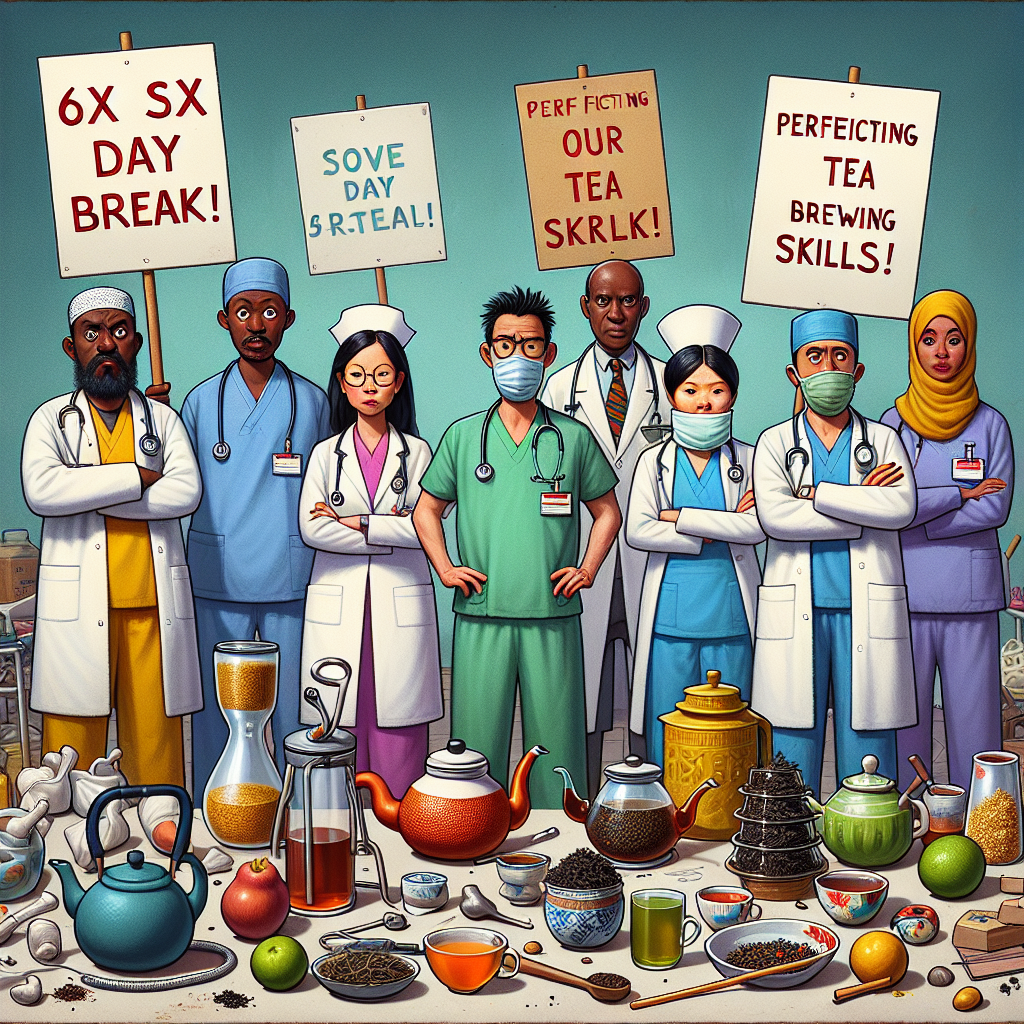
In a bold and seemingly caffeinated decision, the National Health Service (NHS) announced today that doctors across England will embark on a six-day strike, not to negotiate better pay or working conditions, but to perfect their tea brewing skills. The announcement has left patients wondering if they should seek medical attention for their headaches or simply bring biscuits for the doctors.
In the aftermath of the announcement, NHS officials urged patients to only use emergency services when absolutely necessary. One spokesperson, Dr. T. Teapot, said, “We advise you to attend your confirmed appointments, but please remember: a doctor’s perfect tea is paramount to your health. If you can cope without a stethoscope and a scone, do so.”
As the strike begins, doctors are reportedly experimenting with various tea leaves, infusions, and biscuit pairings to achieve the perfect brew. A confidential survey indicated that 93% of doctors believe a well-brewed cup of tea is vital to making life-or-death decisions—“Much like the 1.5 teaspoons of sugar I take in my tea,” Dr. Teapot added.
Patients are encouraged to send in their favourite tea recipes to help inspire the striking doctors. NHS hospitals have set up special ‘Tea Tasting Stations’ where patients can sample various blends while waiting for their consultations. “This is a win-win,” said local patient, Mrs. Brewster. “If I can’t see my doctor, at least I can sip on some Earl Grey and ponder the meaning of life.”
Meanwhile, NHS officials have released a bizarre set of guidelines for patients during the strike. These include:
- Bring your own tea bags for consultations.
- If you feel faint, simply take a seat and channel your inner Britishness.
- Emergency cases will be served tea first and treated second.
In a related development, the NHS has commissioned a study on the psychological effects of various tea strengths on patient wait times. Initial findings suggest that patients who drink stronger tea are 47% more likely to complain about their wait time, while those sipping chamomile are more likely to fall asleep in the waiting room.
Critics have pointed out the absurdity of prioritizing beverage preparation over patient health. “This is the worst kind of distraction from medical practice,” said Professor I. Latte from the Royal Academy of Tea Sciences. “Next, they’ll want to hold a bake sale to fund surgeries!”
Nevertheless, the NHS remains optimistic. In an unexpected twist, they’ve announced a new campaign: ‘Tea for Treatment,’ where patients can exchange their favourite biscuits for a chance to skip the queue. “If you can’t beat them, join them,” Dr. Teapot quipped, “And please, no shortbread. We have standards.”
As the strike continues, patients will have to navigate a bizarre landscape where tea takes precedence over treatment. Only time will tell if this approach will help brew a better healthcare system or just leave everyone in a state of high tea confusion.