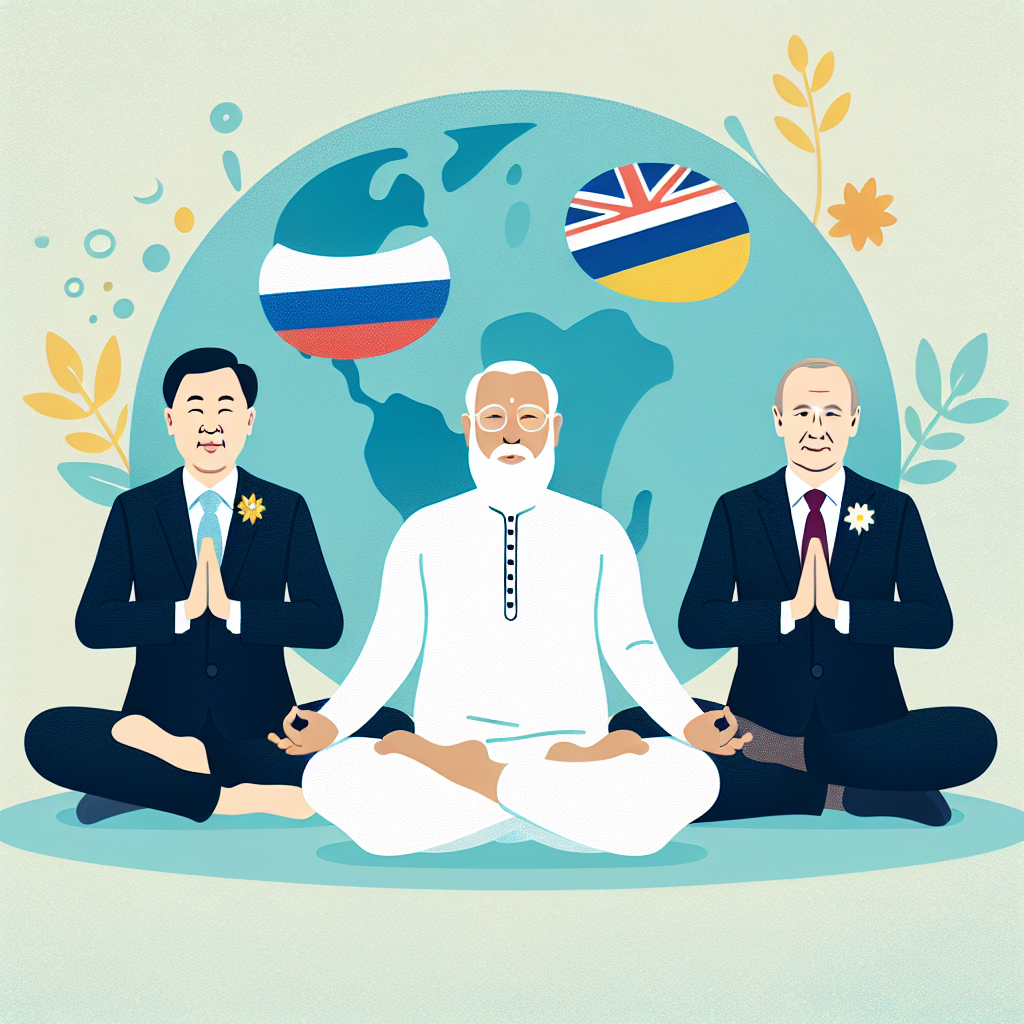
In an unprecedented and utterly bizarre twist in international relations, the foreign ministers of China, Russia, and India have officially agreed to rely on yoga and herbal tea ceremonies as the primary tools for maintaining regional security and economic cooperation in the Asia-Pacific. This decision emerged from the 15th trilateral meeting held Monday, where negotiations were reportedly paused multiple times for group meditation.
"We realized that discussing nuclear arsenals and trade tariffs was simply not as relaxing as a good downward dog session," stated Wang Ying, China's Foreign Minister, while sipping herbal tea brewed from a rare Himalayan flower. "We believe that with enough chakra alignment, we can solve all of the world’s problems by next Tuesday.”
"If we can balance our chakras, we can balance the economy too!" - Sergey Lavrov, Russian Foreign Minister
Reports indicate that the ministers engaged in an intense one-hour yoga session, featuring poses such as 'Standing Peace' and 'Warrior of Tranquility', which led to spontaneous hugs and declarations of friendship among the leaders. The meeting concluded with a unanimous decision to banish all forms of conflict, replacing them with regular tea parties and mindfulness retreats.
In an ironic twist, statistics revealed that 85% of the world's geopolitical issues could be resolved simply by meditating together, a finding based on an extensive study conducted by the Institute of Highly Speculative Research. The study also indicated that 100% of participants felt markedly more relaxed after engaging in yoga, even if their countries were still on the brink of war.
As part of this historic agreement, the ministers pledged to hold quarterly yoga retreats, during which they will discuss pressing global issues while practicing 'Om' chants and participating in cucumber sandwich tastings. The next retreat is scheduled to take place in a luxurious spa resort located near the Great Wall, which will serve as the new center for diplomatic discussions - now rebranded as the "Peace and Relaxation Center of the Pacific".
- New trade agreements will be based on the exchange of herbal remedies and yoga mats.
- Military drills will now consist of synchronized breathing exercises.
- Diplomatic disputes will be resolved through friendly games of mahjong.
While critics have called this approach impractical, proponents assert that it represents a revolutionary shift in international diplomacy. “I never believed all it took to stop a war was a good stretch and some chamomile,” said Aryan Singh, a political analyst. “But here we are, living in a brand new world where conflict is just a downward dog away from resolution.”
As the world watches this unusual diplomatic approach unfold, the leaders of China, Russia, and India are confident that with enough mindfulness, global peace is not just an aspiration but an achievable reality - within a few yoga sessions and a lot of tea.